

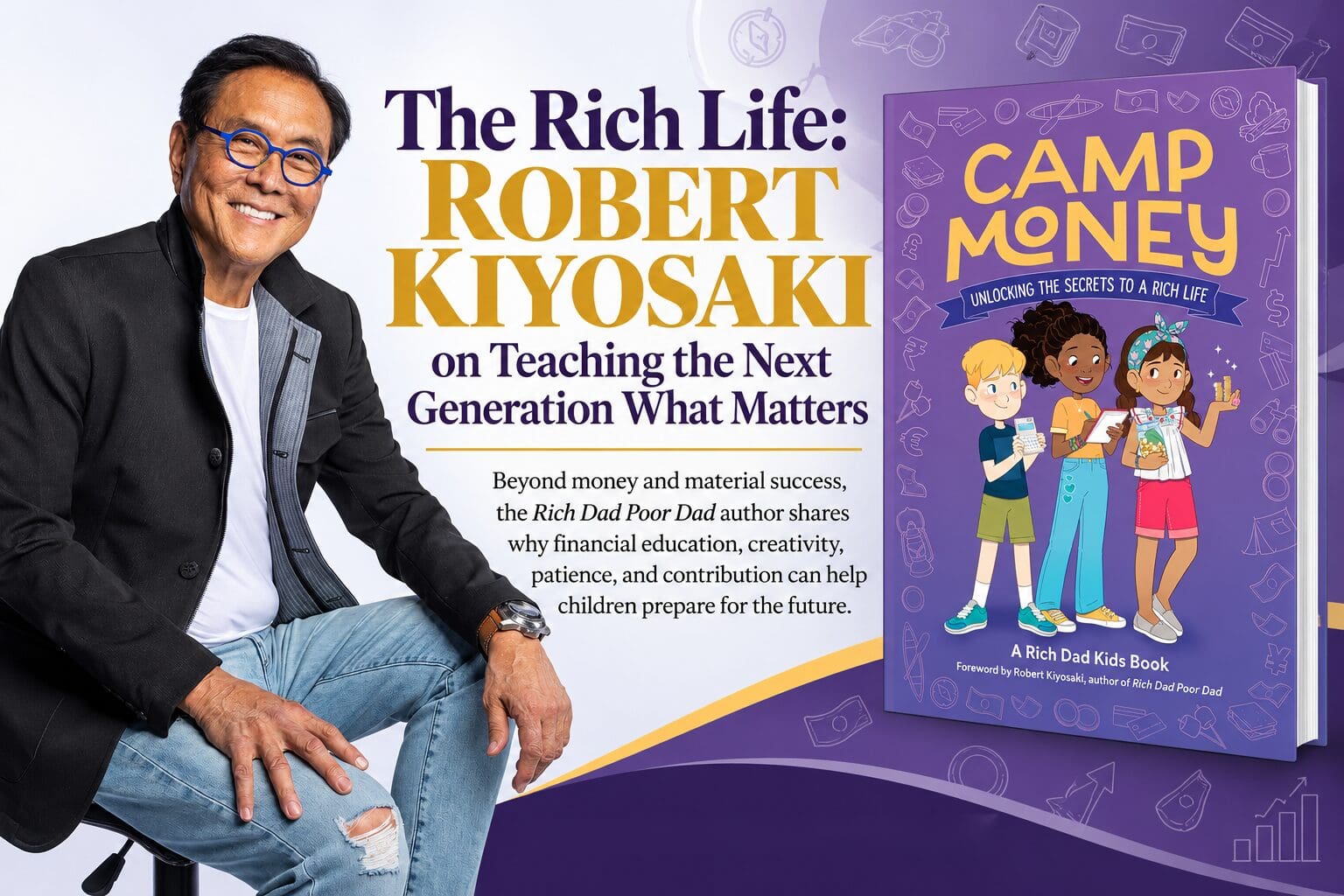
The Rich Life: Robert Kiyosaki on Teaching the Next Generation What Matters
Beyond money and material success, the Rich Dad Poor Dad author shares why financial education, creativity, patience, and contribution can help children prepare for the future.
By Lisa Padilla | Arizona Health & Living
What does it mean to live a rich life?
For Robert Kiyosaki, the answer extends far beyond money. It includes health, happiness, accomplishment, contribution, generosity, and gratitude. Yet understanding money and how it works is also an important part of preparing for the opportunities and responsibilities that life brings.
Best known for his bestselling book Rich Dad Poor Dad, Kiyosaki has spent decades encouraging people to think differently about financial education. Now, with Camp Money: Unlocking the Secrets to a Rich Life, he is bringing that conversation to a younger generation.
In an exclusive interview with Arizona Health & Living, Kiyosaki reflects on the questions that shaped his own childhood, the importance of teaching children about money, and the lessons parents can share long before their children reach adulthood.
His message begins with a question he remembers asking when he was just nine years old.
A question that stayed with him
“When will someone teach us about money?”
Kiyosaki recalls asking his parents, teachers, and anyone who would listen that question as a child. The memory has remained with him throughout his life.
“I remember being a 9-year-old…like it was yesterday,” he shared. “That may seem strange for a guy who’s approaching his 80th birthday next year, but the reason I remember it is because that’s when I started asking — my parents, my teachers, anyone who would listen… — ‘When will someone teach us about money?’”
His recollection points to a challenge many families recognize: children encounter money every day, but they may have few opportunities to understand the decisions and concepts behind it.
“Kids are curious, like I was, at an early age,” Kiyosaki says. “They know what money is… but most likely don’t understand how it works. And starting to learn this life skill at an early age just makes sense to me.”
He believes that knowledge can expand the choices available to people as they grow.
“Like it or not, money is a part of our everyday lives. And the smarter we are about money… the more choices and opportunities our lives will hold.”
For Kiyosaki, financial education is not simply about accumulating wealth. It is about developing an understanding of the world and learning to make more informed decisions.
Bringing financial education to a new generation
Kiyosaki’s latest children’s book, Camp Money: Unlocking the Secrets to a Rich Life, is the first title in the Rich Dad Kids series. Designed for readers ages 8–12, the book introduces financial concepts through characters, adventures, and storytelling.
The Camp Money Kids explore ideas such as value, exchange, generosity, patience, and planning for the future. The approach reflects Kiyosaki’s belief that children can begin developing financial awareness well before they enter the workforce.
Rather than treating financial education as a subject reserved for adults, the series aims to make these concepts accessible to young readers and encourage conversations between children and the adults in their lives.
Kiyosaki believes learning the language of money is an important starting point. Just as people learn specialized terms in medicine, law, or business, he says children can gradually become familiar with concepts that help explain financial decisions.
That vocabulary can include value, exchange, assets, liabilities, profit, loss, and interest. Understanding these ideas takes time, but families can introduce them through ordinary experiences.
The lessons children can learn at home
Parents do not need to have every financial answer to begin teaching their children.
Kiyosaki acknowledges that many adults were never formally taught about money themselves. They learned through experience, trial and error, and the information they gathered as they grew older.
His recommendation is for families to learn together.
“We encourage families to learn about money together,” he explained.
He suggests turning everyday experiences into opportunities for discovery. A visit to the grocery store can lead to a conversation about prices and value. A trip to a bank can prompt questions about saving and debt. Discussions about household expenses can help older children understand how money connects to daily responsibilities.
Kiyosaki even suggests what he calls “Family Field Trips” to places such as banks, car dealerships, and grocery stores.
For families who want to begin, three practical approaches can make financial education part of everyday life.
Start with real choices. When shopping, talk about comparing prices, considering value, and deciding whether something is a need or a want. Keep the discussion appropriate to the child’s age and avoid placing adult financial worries on young shoulders.
Help children work toward a goal. Saving for something they want can introduce patience, planning, and the connection between decisions and outcomes. Children can see their progress and learn that some goals take time.
Make questions part of family life. If a child asks how something works, take the opportunity to explain it. If the answer is unfamiliar, look it up together. Learning does not have to stop because a parent does not know everything.
These steps reflect the broader principle Kiyosaki emphasizes: financial understanding grows through curiosity, practice, and continued learning.
From seeing problems to recognizing opportunities
Financial literacy is only one part of Kiyosaki’s approach. He also encourages parents to help children develop an entrepreneurial mindset.
For him, that begins with creativity and the ability to recognize opportunities. Children can be encouraged to notice problems, ask how something might be improved, and develop ideas of their own.
“They can be supportive and engaged and open-minded,” Kiyosaki says of parents. “They can encourage their children to think creatively, look for problems that are begging for solutions, ways to do things — anything — better.”
Ideas need encouragement and room to develop. Children benefit when adults listen to their questions, support their curiosity, and allow them to explore possibilities rather than expecting every idea to succeed immediately.
This kind of learning does not require making money the measure of achievement. Creativity, responsibility, persistence, and helping others can be valuable outcomes in their own right.
Kiyosaki makes that distinction clear when he describes what he calls a rich life.
“We can measure ‘rich’ in so many different ways…and money is only one measurement,” he says.
“I like to say that our goal is a Rich Life — and that a Rich Life is about more than money. It’s about health and happiness, accomplishment and contribution, generosity and gratitude.”
Those words broaden the conversation about financial wellness. Children can learn to understand money while also learning that their character, relationships, contributions, and wellbeing matter.
Rethinking what education prepares children to do
Kiyosaki has long been critical of what he views as a lack of practical financial education in traditional schools.
He believes students need opportunities to understand more than basic financial tasks. They should also have opportunities to explore how money operates in business, households, and the larger world economy.
He encourages parents to advocate for financial education in classrooms while continuing those lessons at home.
Conversations about rent or mortgage payments, taxes withheld from paychecks, and the changing prices of groceries or gasoline can help children connect financial terminology to familiar situations.
Kiyosaki also points to games and activities as ways to make financial concepts more approachable, mentioning the CASHFLOW game and a Money Word Challenge as examples.
The goal is not to turn every household conversation into a formal lesson. It is to help children recognize that money is connected to decisions they will increasingly make for themselves as they grow.
Why Storytelling Matters
For Camp Money, Kiyosaki and his team chose storytelling as a way to introduce financial ideas to young readers.
The book features eight children from around the world, including Jordan, Divya, Hiro, and Lulu. Through their stories, readers encounter concepts that might otherwise seem abstract or unfamiliar.
“Stories transport us in a way that mere words cannot,” Kiyosaki says.
Kiyosaki’s perspective also speaks to the broader power of storytelling as a tool for learning. By using characters from different backgrounds and sharing their experiences, he hopes to make financial education more engaging and accessible to young readers. The approach reflects an important idea: stories can do more than deliver information. They can help people connect with new concepts, see the world through someone else’s eyes, and remember lessons in a more meaningful way.
He sees the characters and their experiences as a way to communicate the value of education and help children connect with what they are learning.
Storytelling also creates an opportunity for families to continue the conversation after reading.
Kiyosaki encourages parents to ask children what they liked about the Camp Money Kids and their stories, what made sense, and which words or ideas were confusing.
Those questions can help parents discover what their children understand and where they might need more explanation.
A related Camp Money Activity Book, featuring games, puzzles, and challenges, was also announced for later in 2026. The activities are intended to build on the concepts introduced in the story.
For families, the book can serve as a starting point for conversations about money that continue long after the final page.
Patience, responsibility, and the lessons of life
Earning, spending, saving, and investing are connected, Kiyosaki says. Learning how they work together takes time.
“Patience is critical,” he explained. “We’re talking about lifetimes…of learning, applying what we learn, reaping the rewards and, sometimes, learning the lessons from our missteps or losses.”
That perspective offers an important reminder for parents. Financial education is not a single conversation or a skill children master overnight. It develops as they encounter new situations, make decisions, and learn from experience.
Parents can help by creating space for questions, allowing age-appropriate responsibility, and discussing both successes and mistakes without treating every setback as a failure.
In Camp Money, Kiyosaki points to Hiro, the gardener, as a character who teaches patience. The example connects the book’s storytelling approach with a lesson that extends beyond finances: meaningful growth often takes time.
A richer conversation about the future
As the first title in the Rich Dad Kids series, Camp Money is intended to introduce financial concepts to a new generation through imaginative storytelling.
But Kiyosaki’s interview also raises a larger question for parents, grandparents, and educators: What do we want children to understand before they step into adulthood?
Financial knowledge matters. So do curiosity, patience, creativity, responsibility, and the ability to recognize opportunities. And as Kiyosaki’s description of a rich life suggests, financial success is only one part of a meaningful future.
Families do not need to wait until children are teenagers to begin those conversations. They can start with the questions children already ask, the decisions they observe, and the experiences they share.
For Kiyosaki, the conversation about money should continue throughout life. His advice to families is to pay attention to the world around them and use current events to help children make connections.
Whether the subject is prices, jobs, interest rates, or energy, he believes there are opportunities to learn.
The first step may be as simple as listening to a child’s question—and taking the time to explore the answer together.
Because preparing the next generation for the future is about more than teaching children how money works. It is also about helping them develop the understanding, confidence, and perspective to decide what a rich life means to them.
About the book
Camp Money: Unlocking the Secrets to a Rich Life is the first children’s book in the Rich Dad Kids series and is designed for readers ages 8–12. The book is scheduled for release November 10, 2026.
For more information, visit Rich Dad Kids.
About this interview
This article is based on an interview with Robert Kiyosaki. His views are presented as those of the interviewee. The article is intended for general educational purposes and does not constitute individualized financial advice.
