

Arizona Ranks No. 8 in Estimated OnlyFans Spending Per Adult, According to New Study
By Lisa Padilla | Arizona Health & Living
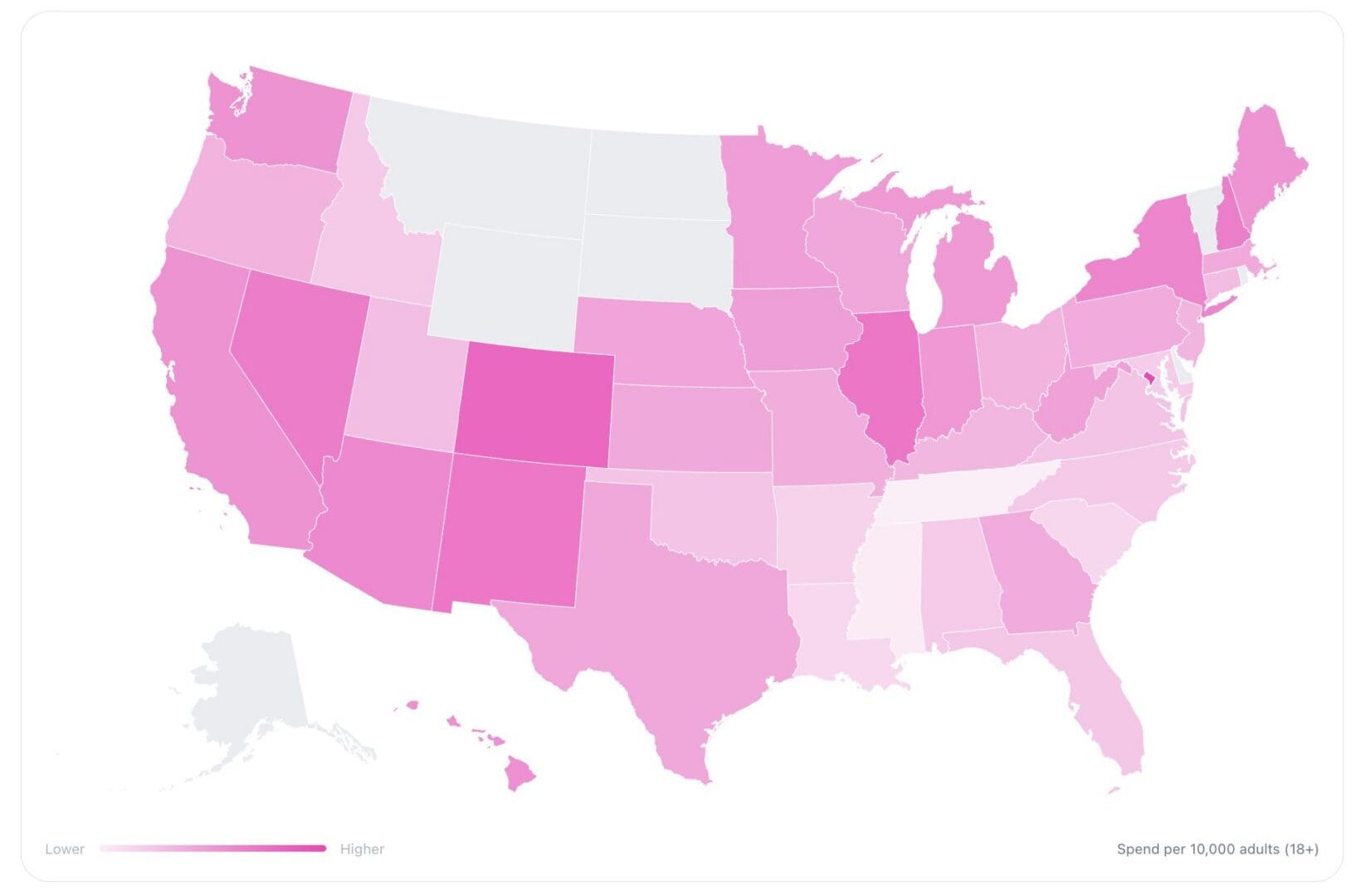
Arizona ranks No. 8 nationally for estimated OnlyFans spending per adult, according to a new analysis from OnlyFinder. The report’s 2026 estimate places Arizona at $210,053.54 per 10,000 adults, up 12.22% from the 2025 estimate of $187,180.68.
The study also places two Arizona cities among the top 20 globally for estimated spending per adult. Tucson ranks No. 19, with an estimated $332,455.88 per 10,000 adults, while Phoenix ranks No. 20, at $324,953.12.
In an interview with Arizona Health & Living, Max Anderson, CEO and owner of OnlyFinder, discusses the study’s findings, how the company developed its geographic spending estimates and what the numbers can — and cannot — tell us about consumer behavior.
What Arizona’s Rankings Show
Arizona’s No. 8 national ranking is based on estimated spending per 10,000 adults, rather than total statewide spending.
The report’s estimates also place Tucson slightly ahead of Phoenix in per-capita spending. However, Anderson cautions against drawing a firm conclusion from the difference.
“We can say both cities are around top 20 globally in per capita spend. But we cannot confidently say Tucson outspends Phoenix or vice versa. Per capita spend in the two cities is very similar,” Anderson says.
The rankings provide a geographic comparison based on the study’s model, but they do not establish how much individual residents spend or how many subscribers live in each location.
How the Study Estimates Spending
OnlyFinder’s analysis combines financial information, Google Ads Keyword Planner search-volume data, activity across its advertising network and population estimates to develop geographic spending estimates.
The financial baseline includes approximately $7.843 billion in gross site volume reported by Fenix International Ltd. for the fiscal year ending Nov. 30, 2025. The study uses this company-level figure alongside selected search terms and geographic data to estimate how spending may be distributed across countries, states and cities.
According to Anderson, the analysis draws on 14,527 selected keywords and approximately 177 million keyword-location-month search-volume data points. The study covers 217 countries and 309 cities.
Anderson explains that OnlyFinder also uses activity across its website and more than 100 partner websites to examine the relationship between search activity, referrals to creator profiles and downstream subscriber spending.
The company says its tracking data helps connect certain search activity to subscriber conversions and spending. However, that information does not mean every geographic estimate represents a verified transaction.
What the Numbers Cannot Tell Us
The distinction between modeled estimates and direct transaction data is important when interpreting the rankings.
Anderson says the geographic figures are estimates rather than a direct measurement of purchases made by consumers in each location.
“They are modeled estimates of spending, not a direct measurement of actual transactions in each location,” Anderson explains.
The geographic estimates have not been independently validated against credit card transaction data linked to subscribers’ billing addresses. Anderson says that information is not available to the company in a format that would connect purchases on OnlyFans to the billing address of each fan.
The report also does not publish a formal margin of error, confidence interval, standard error or other statistical uncertainty range for its state and city estimates.
“The study does not publish a margin of error, a confidence interval, a standard error, or any other uncertainty range for its state or city estimates. Every figure is a single point estimate,” Anderson says.
Anderson offers his own practical assessment of possible uncertainty in the underlying search-volume data and the relationship between the selected search terms and spending. That assessment is his judgment, not a formal statistical margin of error established by the study.
Understanding the Rankings
The Arizona results provide a snapshot of how digital activity can be analyzed to estimate consumer spending across different markets. They also illustrate why rankings need context.
A city’s position in a study does not necessarily establish how much its residents actually spend. Similarly, a higher modeled estimate does not prove that one city has more paying subscribers or greater total spending than another.
For Arizona, the study places the state at No. 8 nationally and Tucson and Phoenix among the top 20 cities globally for estimated spending per adult. Those findings are worth noting, provided the figures are understood for what they are: estimates generated through the study’s methodology.
Readers can review the full report and its findings at OnlyFinder’s OnlyFans Wrapped 2026 report.
Image courtesy of OnlyFinder.
This article is based on an interview with Max Anderson, CEO and owner of OnlyFinder. His comments and explanations are presented as his own and reflect his perspective on the study and its methodology.
The spending figures discussed in this article are modeled estimates based on OnlyFinder’s published methodology. They should not be interpreted as verified individual consumer transactions or independently confirmed spending totals for each geographic location.
Arizona Health & Living shares local events, businesses, and community stories that help Arizona residents discover what’s happening across the state.
